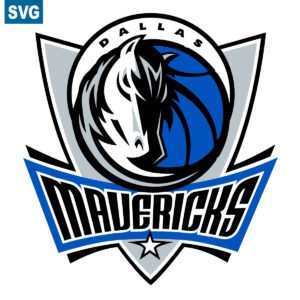
Dallas Mavericks Logos
Designing with the Dallas Mavericks Primary Logo: Envelope Distortions and the Typography Breakdown
The Dallas Mavericks possess one of the most aggressive and highly stylized visual identities from the early 2000s NBA era. Built around a fierce stallion, a silver basketball, and a rigid shield, the emblem perfectly captures Texas bravado.
However, as a professional logo designer and creative director with over 30 years of experience, looking at this asset from a technical print and digital standpoint reveals severe structural flaws. If you are an art director, content creator, or sports marketer utilizing the high-resolution JPG, transparent PNG, and vector SVG versions of this modern Mavericks emblem, you must look past the metallic textures and analyze how the layout functions in real-world design environments.
An Expert Typography Critique: The Envelope Distortions and Readability Failures
While the horse illustration itself is highly effective, the typography layout underneath it is a textbook example of poor functional design. In my expert opinion, the typography on this logo is a complete mess and, frankly, a disservice to the team’s loyal fan base.
The word “Mavericks” suffers from a severe readability crisis caused by what we call in Adobe Illustrator an “Envelope Distort” or warp effect. The center of the text block is compressed and squished vertically while the outer edges flare out. This specific distortion completely ruins the natural tracking and kerning of the characters, forcing the viewer to strain to read the word.
To make matters worse, the customized typeface selected for the brand does nothing to aid legibility. Look closely at the letter “E” in “Mavericks”—it is poorly engineered and structurally broken; it barely even resembles an actual letter “E.” Furthermore, the word “DALLAS” is tucked away at the top in a micro-scale font body that completely vanishes when the logo is scaled down for mobile screens or digital favicons. It is a frustrating piece of vector artwork that prioritizes 2000s-era “coolness” over fundamental graphic design laws.
Showing all 3 results